← Technology, Science & Infrastructure
▣ Distilled locally
Doom Comes to a USB Flash Drive Near You
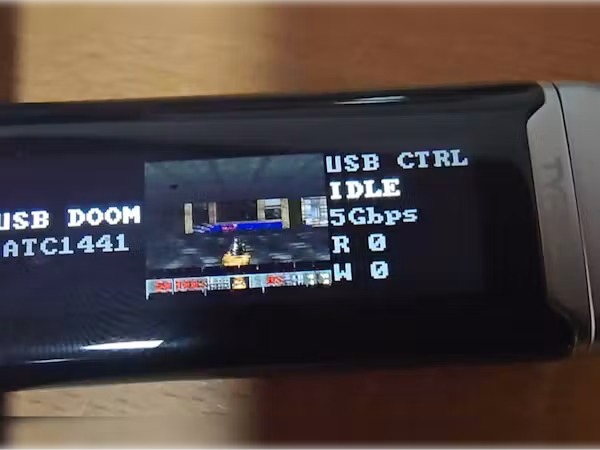
The list of devices capable of running Doom keeps getting longer — and stranger. Over the years, the classic first-person shooter has found its way onto everything from thermostats to electric toothbrushes. Now, hardware hacker Aaron Christophel has added another unlikely device to the list: a USB flash drive. Without any available buttons, Christophel had to come up with a very odd way to control the game once he got it working. The device in question is a MOVESPEED MSSU10, a 128 GB USB flash drive with a built-in color display. Normally, its screen shows information like storage capacity, transfer speeds, and temperature. But Christophel discovered that the hardware responsible for driving the display was powerful enough to do quite a lot more. Inside the flash drive are two separate processors. A Silicon Motion SM2320G handles USB 3.2 Gen 2×2 connectivity and storage operations, while a C*Core CCM4101 microcontroller manages the 428×142-pixel LCD. The latter features an Arm Cortex-M4F core, 128 KB of SRAM, and 2 MB of SPI flash memory. Although the microcontroller is supposedly capable of running at 200 MHz, Christophel measured its actual operating frequency at just 40.2 MHz. That was disappointing, but it didn't stop him from getting Doom running on it. The project builds on DMC100-DOOM, a heavily optimized port developed by Artur Bieniek for extremely resource-constrained hardware. Christophel adapted the software to the MOVESPEED's display controller, reverse-engineered the necessary hardware interfaces, and developed custom firmware that replaces the original display software. The result is a playable version of Doom running at about 13 frames per second, with game logic operating at the normal 35 ticks per second. Memory limitations mean that only the first level, E1M1, is available, and there's no sound. But getting the game running was only half the challenge. The flash drive doesn't have any buttons, and its display controller can't communicate directly over USB. So how do you actually play? Christophel came up with a solution that uses the drive's read and write activity as a control interface. The display controller communicates with the storage processor over I²C to monitor data transfers. By generating carefully timed reads and writes from a computer, a Python program can translate keyboard inputs into actions within the game. The modified drive continues functioning as ordinary USB storage because its main storage controller remains untouched. Anyone interested in trying the project can find the source code, prebuilt firmware, and flashing instructions on GitHub . You'll need an SWD debugging probe to install the firmware, but no additional hardware is required to play afterward.Playing Doom on a USB drive (📷: Aaron Christophel) A look inside the enclosure (📷: Aaron Christophel)
↑ Back to top
Originally published by Hackster News ↗
· rebuilt here from its own full-text RSS feed · all rights
remain with the publisher, please read and support them there.