November 23 and 24 evenings: Supermoon near Aldebaran and Pleiades
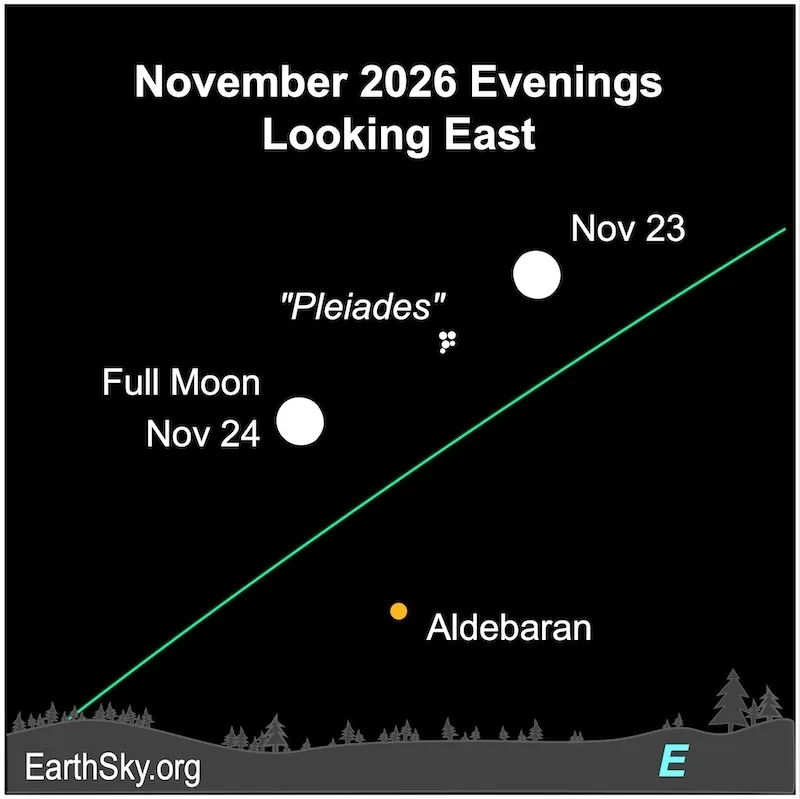
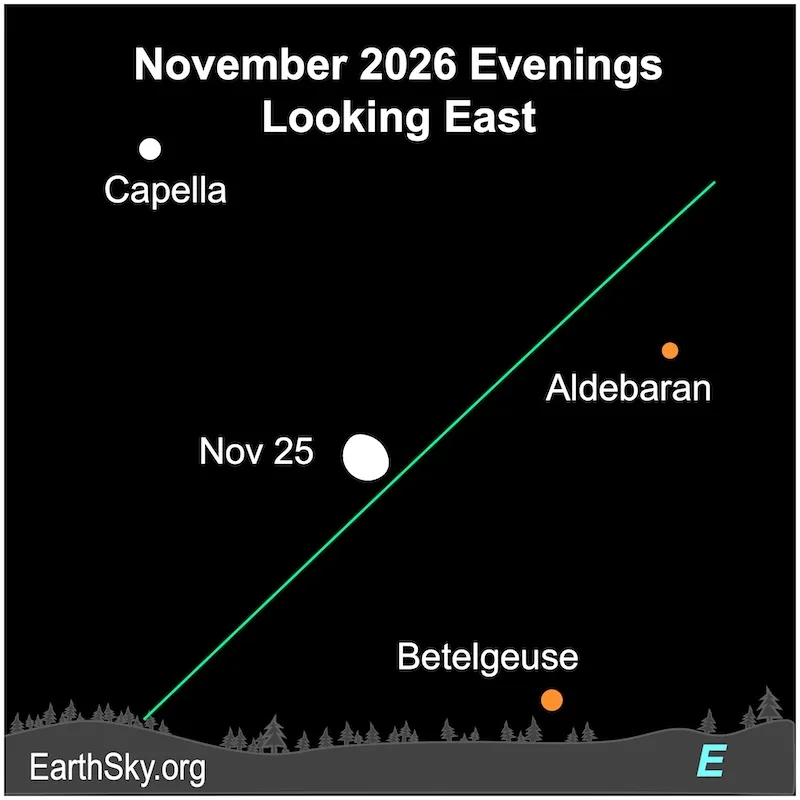
On the evening of November 23, the bright waxing gibbous moon — almost full — will shine near the brightest star of Taurus the Bull, Aldebaran. Plus, the Pleiades star cluster will be nearby. Can you see the misty star cluster near the bright glow of the moon? The crest of the full moon will occur at 14:54 UTC on November 24. That’s 8:54 a.m. CST. So the moon will appear most full in the Americas on the morning of November 24. Then the moon will appear full on the night of November 24. And it’s the 1st of 4 supermoons in a row. Chart via EarthSky.
Our charts are mostly set for mid-latitudes in the Northern Hemisphere. To see a precise view — and time — from your location, try Stellarium Online.
Mercury is farthest from the morning sun this week
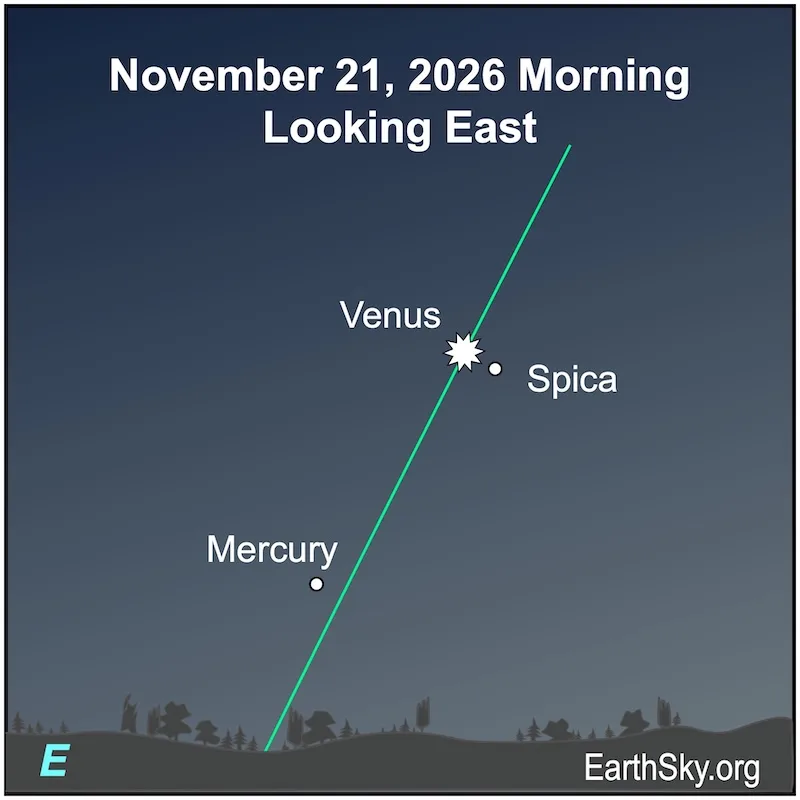
Any morning this week is a great time to look for Mercury. The inmost planet of the solar system reached its greatest distance from the sun on the sky’s dome on November 21. For all of us on Earth, it lies in the brightening morning twilight, closer to the sunrise point than brilliant Venus. Mercury will be easiest to see from the Northern Hemisphere. But Southern Hemisphere observers might glimpse it, too! ESA’s 2 BepiColombo spacecraft successfully entered orbit around Mercury on November 21. You can read about BepiColombo here. Chart via EarthSky.
The bright winter stars are returning to our evening sky! Orion the Hunter, Taurus the Bull and other familiar constellations are coming back into view. And here’s something you might not realize. As you look toward these stars, you’re looking toward the nearest outer edge of our Milky Way Galaxy. What’s out there? And how can you know where to look? EarthSky’s Deborah Byrd has the story. Come on, star people! Let’s explore. Watch here or on YouTube.
Late November morning planets
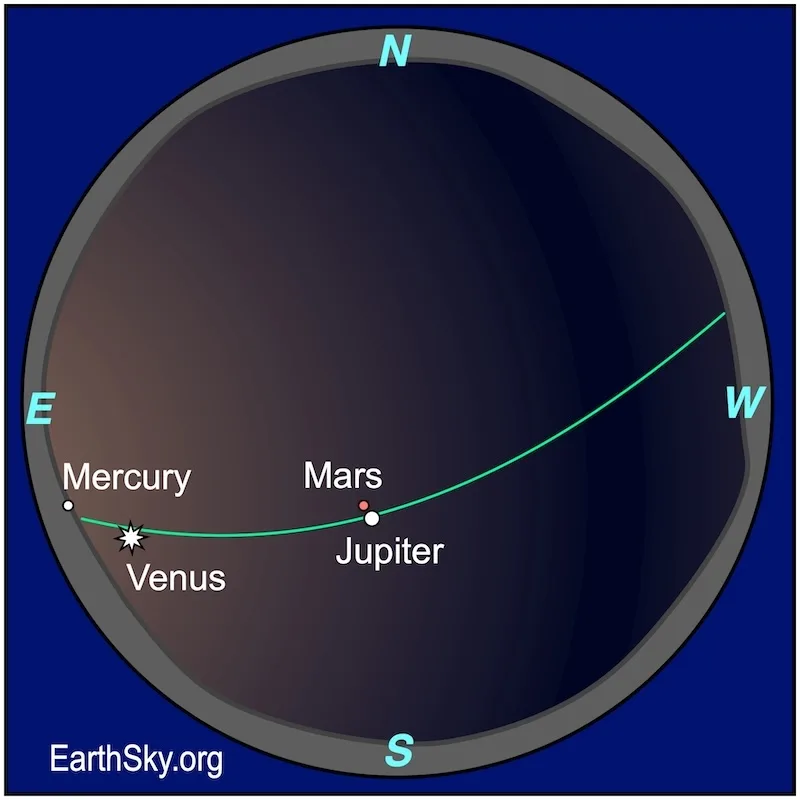
In late November, as viewed from the Northern Hemisphere, look for brilliant Venus low on the eastern horizon and Mercury even lower. Mercury reached its greatest distance from the sun on November 21. And Venus will reach its greatest brilliancy — its brightest in the morning sky — on November 29. Above them will be the planets Jupiter and Mars. Chart via EarthSky.
Late November — around midnight
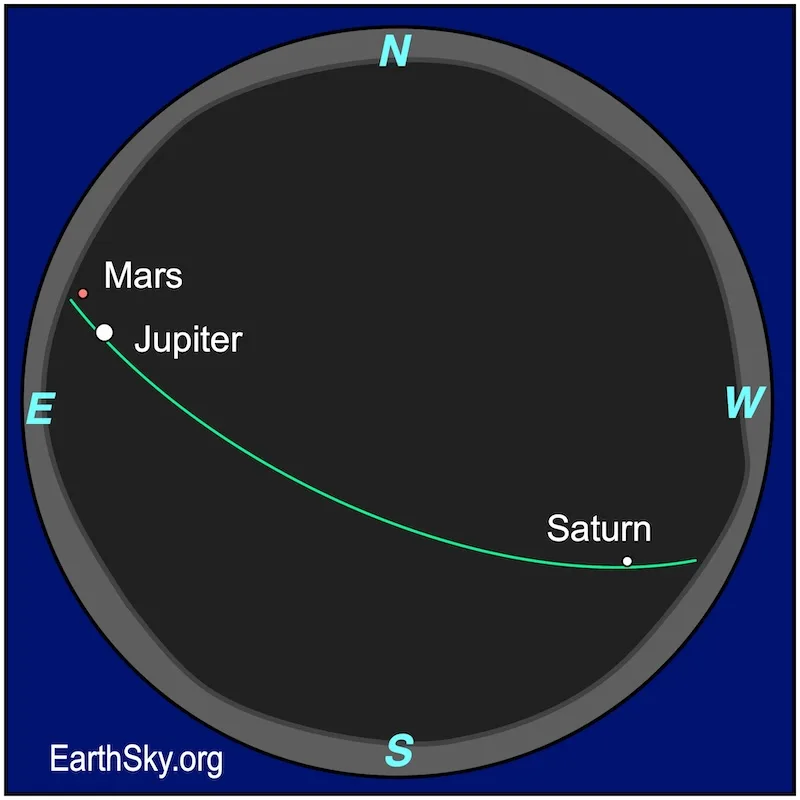
Around the middle of the night in late November, there will be 3 bright planets in the sky. The brightest — Jupiter — is rising in the east, followed by red Mars. And Saturn is descending in the west. Chart via EarthSky.
November 26 and 27 evenings: Moon near the twin stars
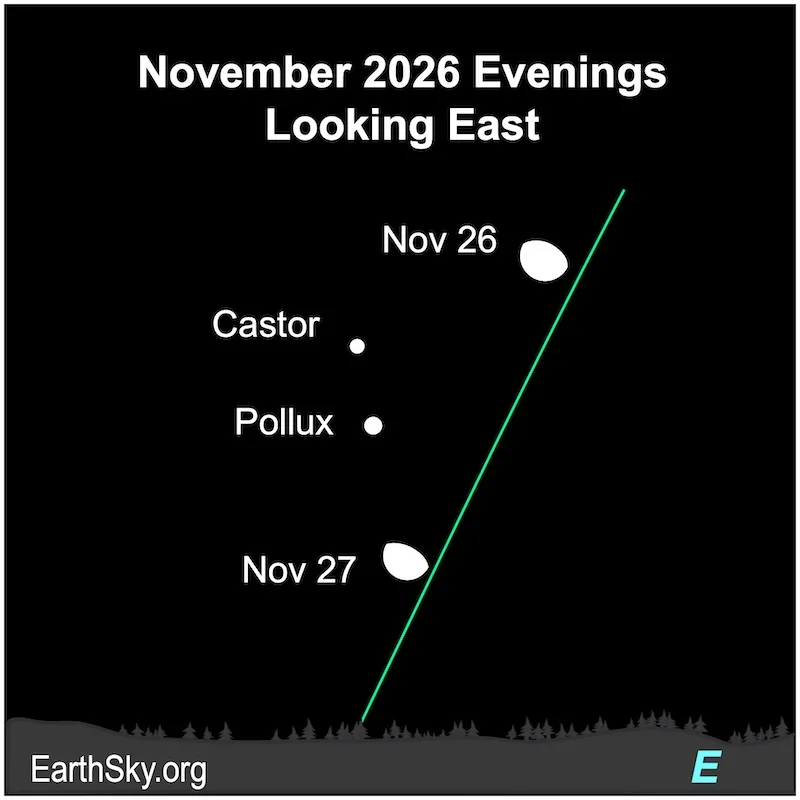
A few hours after sunset on the evenings of November 26 and 27, the waning gibbous moon will float near Castor (the dimmer twin star) and Pollux (the brighter twin star) in Gemini the Twins. You can catch them all night until dawn. Chart via EarthSky.
November 29 and 30 mornings: Moon near Jupiter, Mars and Regulus
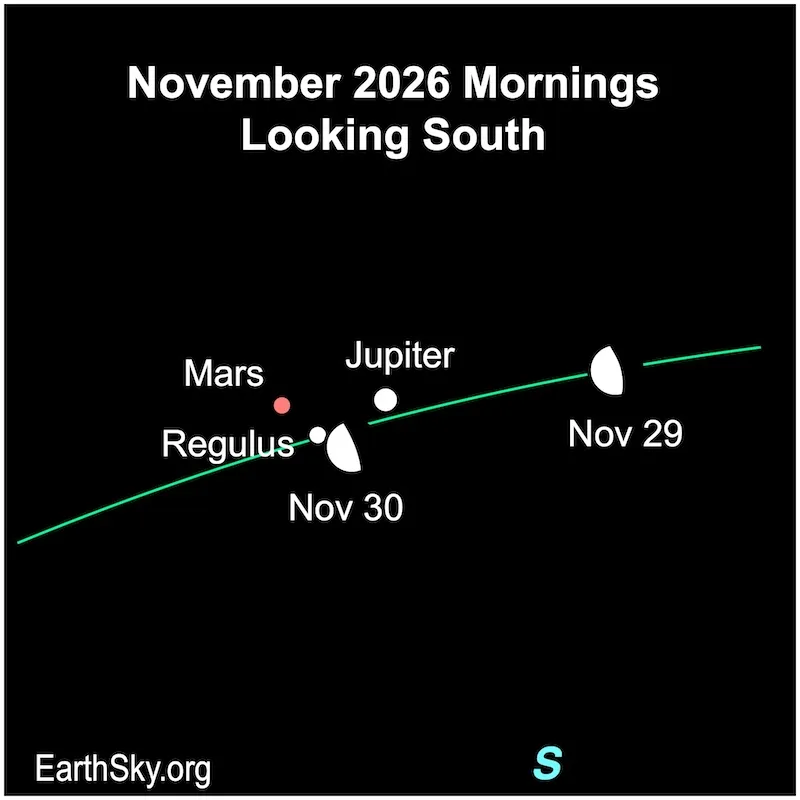
The moon approaching its third quarter phase lies high in the east before dawn on the morning of November 29. Jupiter, Mars and the bright star Regulus are nearby. On the following morning, November 30, the moon, Jupiter, Mars and Regulus make an eye-catching tight group in the morning sky. Chart via EarthSky.
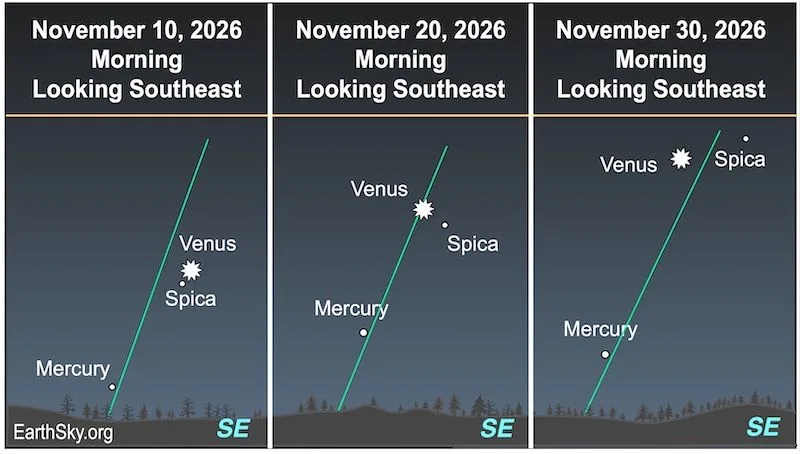
Mercury will reach its greatest elongation from the sun at 0 UTC on November 21, 2026. In early November, from the Northern Hemisphere, Mercury will lie low in the east shortly before sunrise. Brilliant Venus and the star Spica are next to each other and far above Mercury. After the middle of the month, Mercury will have brightened and climbed toward Venus and Spica. By month’s end, Mercury will have begun to descend, and it will slip away by mid-December. Chart via EarthSky.Bright Jupiter will lie high in the east a few hours before sunrise in early November. Mars will be above it with the star Regulus below. By mid-month, Mars will drop below Jupiter. Near the end of November, Mars will leave Jupiter behind and and sink toward Regulus. Chart via EarthSky.
November stars
If you’re out stargazing on any November evening, look for these stars and constellations in the evening sky.
On November and December evenings, when W-shaped Cassiopeia the Queen rides high in the north, her husband on the sky’s dome, Cepheus the King, does, too. The house-shaped Cepheus lies inside a triangle formed by the Little Dipper, Cassiopeia and Cygnus the Swan (or the Northern Cross).Find Perseus with the help of the constellation Cassiopeia the Queen. Cassiopeia’s distinctive M or W shape is ascending in the northeast on Northern Hemisphere autumn evenings, with Perseus following. Cassiopeia and Perseus travel together in a great arc around the northern sky. Be sure to look for the star Algol, sometimes called the Ghoul Star or Demon Star. Chart via EarthSky.Here’s an easy way to use the prominent M or W shape of Cassiopeia to locate the Double Cluster in Perseus.
Our charts are mostly set for the northern half of Earth. To see a precise view — and time — from your location, try Stellarium Online.
Here is the sky dome view for November 2026. It shows what is above the horizon at mid-evening for mid-northern latitudes. The view may vary depending on your location. Image via Guy Ottewell’s 2026 Astronomical Calendar.
Visible planets and night sky guide: Tonight, spot the nearly full moon near Aldebaran and the Pleiades. Tomorrow morning, enjoy the first of four consecutive supermoons!
↑ Back to top
Originally published by EarthSky ↗· rebuilt here from its own full-text RSS feed · all rights
remain with the publisher, please read and support them there.