CopilotKit Releases CLiF: A Continual Learning Platform That Turns Agent Traces and User Actions into Skills, Evals, and Fine-Tuning Data
Introduction
Teams shipping AI agents at scale keep running into the same pattern. Even agents built on top-tier models like Fable and Astra struggle to carry out complex, end-to-end tasks inside a specific product consistently enough to deploy. So teams grind out evals for the workflows that matter most, often hundreds or thousands of hand-written cases, and then improve the agent bit by bit through prompt edits, harness fixes, and special cases until it passes enough of them to go live.
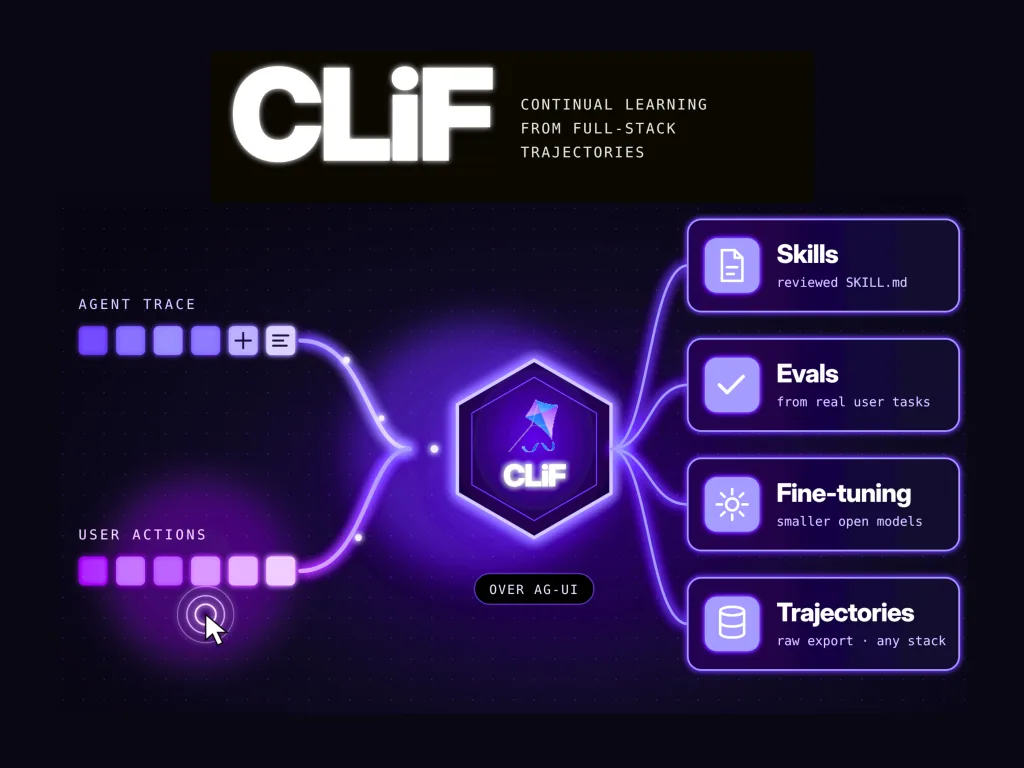
Meanwhile, the product’s own users carry out those same tasks every day, and know which actions to take and in what order. CopilotKit, the company behind the open-source CopilotKit framework and the AG-UI protocol, released CLiF, a platform for continual learning from full-stack trajectories, in early access. CLiF securely captures what the agent does and what users do in the product, and turns that record into skills, production-based evals, and fine-tuning datasets, all exportable along with the raw trajectories.
CopilotKit is open source, with more than 38,000 stars on GitHub.
- Agent tracing shows where an agent went wrong, while the correct path lives in what users do in the product, which most stacks never capture.
- CLiF, now in early access, learns from full-stack trajectories: the agent trace and the user’s actions in the product, securely captured as one timeline over AG-UI.
- A four-stage loop, built on CopilotKit’s Automatic Learning, turns those full-stack trajectories into skills, production-based evals, fine-tuning datasets, and raw exports, with a human reviewing every skill.
- A worked example shows how agents learn the way team leads actually close out a sprint.
- CLiF targets the pains slowing agent teams, including evals, context bloat, cost, fragmented stacks, and shadow AI usage, and runs fully self-hosted.
What Agent Tracing Misses
Most agent observability today is centered on the agent. Tracing tools capture prompts, tool calls, and model outputs, which shows where the agent went wrong while leaving the correct path out of view. Product analytics covers the other side with clicks, funnels, and session replays, though that data is built for a person reading a dashboard rather than for teaching an agent a task or testing it. In most production agent stacks, the two never end up on the same timeline.
That gap matters because the agent learns a product from prompts, skills, tool descriptions, and exposed APIs, and has to work out on its own how those pieces fit together for a real task. The people using the product have already solved that, often hundreds of times. CopilotKit’s view, laid out in its explainer on agent learning, is that how users actually get work done is the most valuable dataset any agent team has, and that it is rarely captured in a form an agent can learn from.
Full-Stack Trajectories: The Training Signal CLiF Is Built On
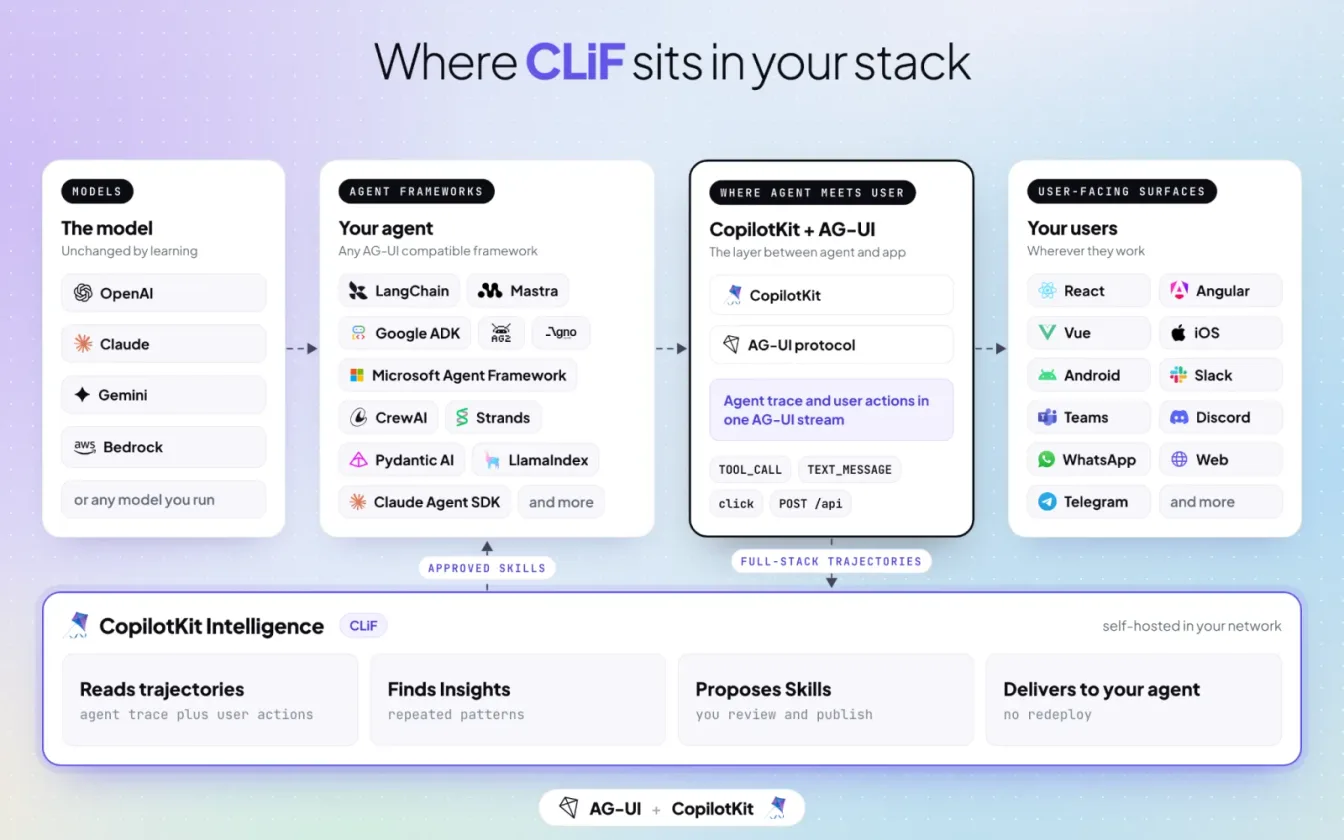
CLiF is part of CopilotKit Intelligence and is built around a single primitive, the full-stack trajectory. It is captured through AG-UI (Agent-User Interaction Protocol), the open protocol CopilotKit created to connect agents to user-facing applications. Because AG-UI sits between the agent and the user on any surface, it can see both sides of a task:
- Agent trajectory (agent trace): every run, tool call, and state change the agent made, and what each one returned.
- Product trajectory (user actions): what was on the user’s screen, the buttons they clicked, and the server requests they triggered. If the user talks to the agent along the way, that conversation lands on the same timeline, in order.
Together, that is a full-stack trajectory.
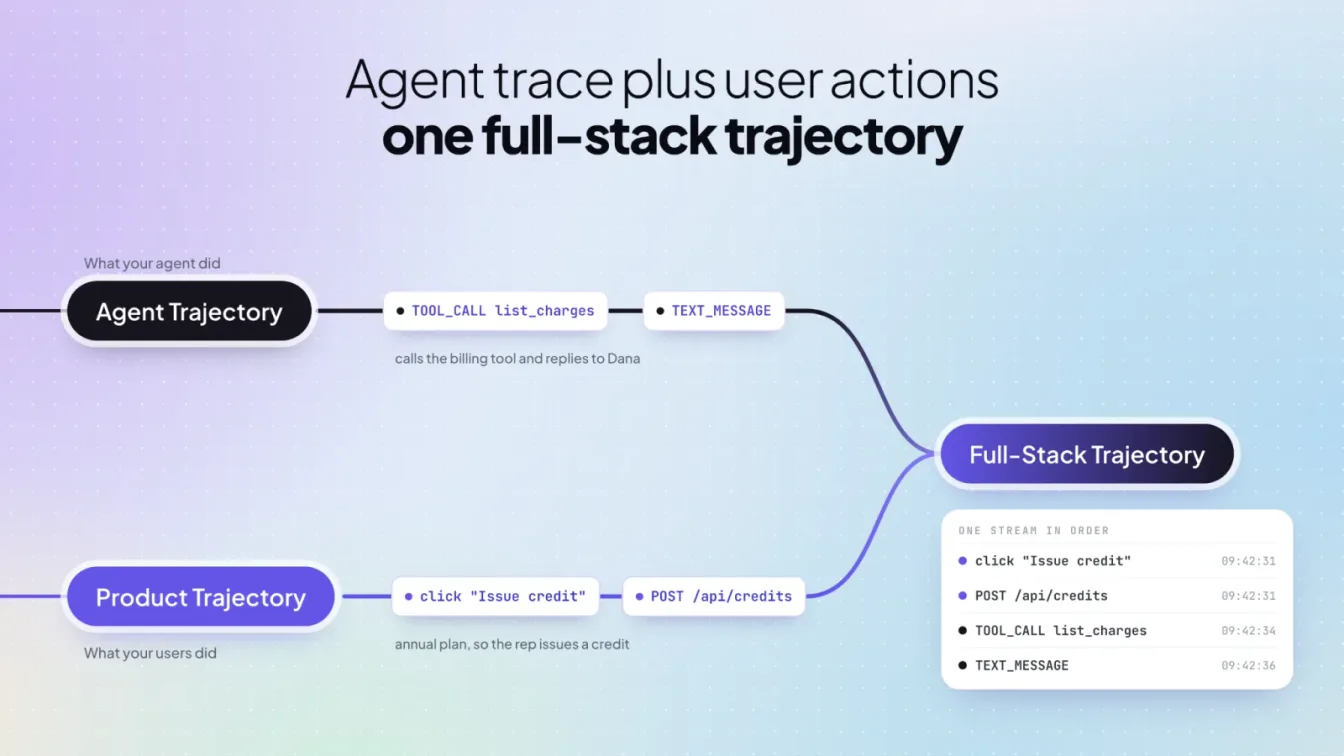
AG-UI already streams the agent’s events to the frontend, so securely capturing user actions over the same protocol puts both halves in one stream from the start, with no separate analytics pipeline to stitch them together later. Each user session becomes a single trajectory that a team can open in CopilotKit Intelligence and replay step by step, with clicks, server requests, and agent messages in the order they happened.
Inside CLiF: From Trajectories to Skills, Evals, and Training Data
CopilotKit describes the learning loop in four stages.
1. Capture. Trajectories stream into CopilotKit Intelligence and are assigned to learning containers, which scope learning to one kind of work, such as billing support or customer onboarding. The runtime picks the container for each session through the getTrajectoryLearningContainerIds callback, and sessions can be moved in or out of a container later in the Intelligence UI. Each container learns only from its own sessions.
2. Find patterns. Analysis runs on a schedule once a container passes a set threshold of new sessions, and teams can also trigger it manually. Each run works from a frozen snapshot of the container’s sessions and surfaces Insights: recurring requests, repeated corrections, and the friction users quietly work around. CopilotKit sees that friction as the strongest signal, since it tends to repeat across thousands of sessions and shows exactly what the agent should learn next. Every Insight cites the specific events behind it and links straight to the source trajectory.
3. Review. When the evidence supports a reusable lesson, CLiF proposes it as a skill, written as a plain SKILL.md file. The analysis service cannot publish anything on its own: a person approves or rejects each proposal, either in the Intelligence UI or through the CopilotKit CLI. Published skills are versioned and can be retired at any time.
4. Deliver and export. Published skills reach the agent without a redeploy, and teams that need stability can pin the agent to a fixed skill revision. For any other agent or MCP server, skills can be downloaded as plain files with copilotkit skills download <container> –output <dir>. The trajectories themselves can be exported as raw event data from the Intelligence dashboard. For early access teams, the same pipeline also produces eval candidates and fine-tuning datasets from these trajectories.
Agent Trajectories: Automatic Learning in CopilotKit Intelligence
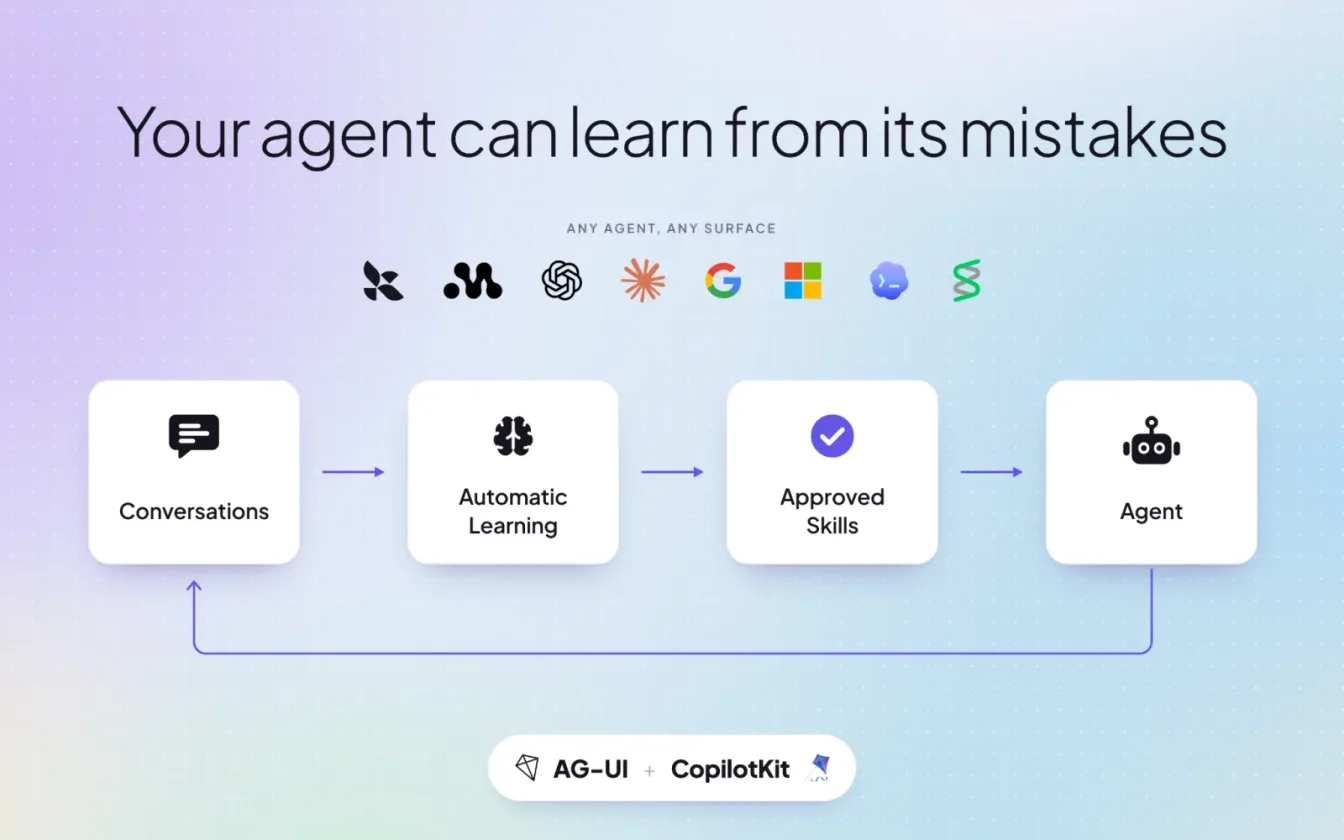
On the agent side, CLiF builds on Automatic Learning, the capability in CopilotKit Intelligence that CopilotKit also positions as the foundation for self-improving agents. Automatic Learning learns from the conversations users have with the agent. CLiF extends the same loop to product trajectories, so it also learns from the work users do directly in the product, outside the chat.
Every agent conversation is stored in full through AG-UI Streams: messages, tool calls, generative UI, state, approvals, and files. Developers choose which threads count as evidence by returning a container ID from the getLearningContainerId callback on the CopilotKit runtime, which is the agent-side counterpart to the trajectory callback. Teams that already have an agent in production can import existing history from a LangGraph Server or LangSmith Deployment instead of starting from zero.
Skill delivery works through adapters for LangGraph (Python and TypeScript), Mastra, Google ADK, Microsoft Agent Framework, CopilotKit’s built-in agent, and more. The adapter adds a catalog and two tools, copilotkit_load_skill and copilotkit_read_skill_file, and the model loads a skill when the task calls for it. Developer instructions keep precedence, so skills cannot override the agent’s role, safety rules, or tool restrictions.
Beyond Skills: Evals, Fine-Tuning Data, and Raw Trajectories
Skills are only the first output. The same trajectories feed four outputs in total, all exportable into a team’s existing stack:
- Skills for agents or MCP servers, built from patterns that recur across many sessions.
- Production-based evals, built from tasks users actually performed, including the inputs and edge cases nobody thought to write by hand. These can be exported to the eval platform a team already uses.
- Fine-tuning datasets drawn from real task trajectories, intended for training smaller, faster open models on a company’s most frequent workflows.
- Raw full-stack trajectories that can be exported to any observability platform or used however a team wants.
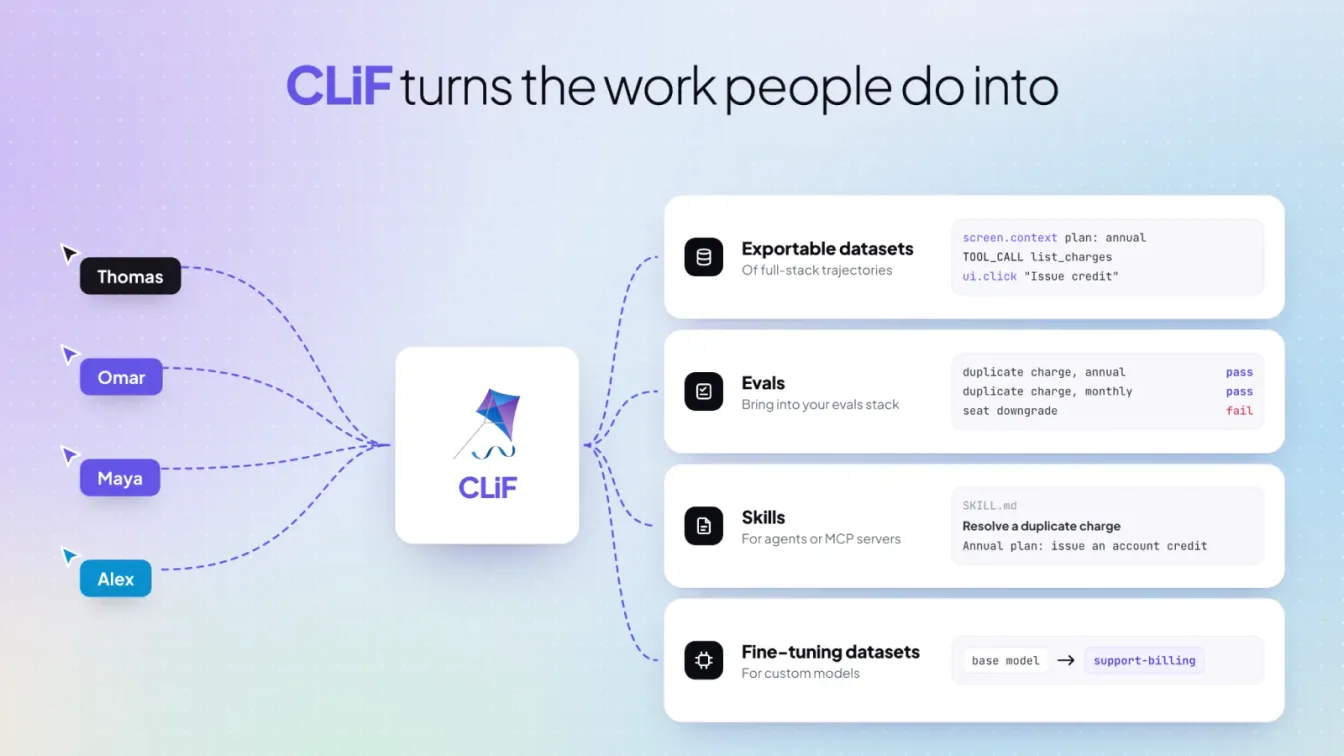
CopilotKit’s view is that teams should keep the eval and observability tools they already use, and CLiF supplies the data those tools have been missing.
CLiF in Action: A Practical Example
Say you’re the CTO of a project management platform similar to Linear, where engineering teams plan sprints and track issues. You want agents to take over routine work in your product and do it reliably, both your own built-in agent and external agents like Claude that customers connect through your MCP server. Sprint close-out is one of the first tasks on the list.
Your platform already has a one-click option that moves every unfinished issue into the next sprint, and your docs describe close-out exactly that way. So an agent asked to close out a sprint does just that, and moves every unfinished issue forward.
Once CLiF is securely capturing product trajectories, thousands of close-outs show that team leads on your platform do more than that. Most use the one-click option, then spend the next few minutes fixing the result:
- They move issues that were already carried over once back to the backlog and unassign them.
- They comment on blocked issues, tagging whoever owns the blocker.
Nobody on your team designed this routine, and few users would describe it if asked. It exists only in the clicks and requests that follow the one-click move. Agent traces never see it, because users do it themselves. Product analytics records the extra clicks without their meaning, and spotting the pattern in session replays would mean watching thousands of recordings.
CLiF surfaces the routine as an Insight, citing the exact sessions behind it, and proposes a skill for the full close-out. After your team reviews and publishes it, your built-in agent picks it up without a redeploy, and you ship the same skill with your MCP server so Claude and other connected agents follow it too. As user habits change, new sessions keep the skill current, and the Insight also shows you where your own feature falls short.
The same sessions become eval cases that check whether an agent handles each issue the way team leads on your platform do, so you can confirm agents are ready before handing them the task. They can also become training data if you later fine-tune a smaller model for planning work.
How CLiF Addresses the Pains Slowing Agent Teams in 2026
For technical leaders running agents at scale, CopilotKit frames CLiF as a response to a familiar set of problems.
- Getting agents past evals: For most teams, the slowest part of shipping an agent is getting it to pass enough evals on the workflows that matter. Skills learned from how users complete those workflows give the agent the steps it was missing. Production-based evals then add the edge cases users hit in practice, so the suite keeps growing with real usage.
- Context bloat and tool overload: Each agent mistake tends to end with one more rule in the system prompt or one more tool on the agent. Over time, the context fills up, and behavior gets harder to predict. CLiF keeps learned behavior in a skill catalog instead, and the model loads a skill only when the task calls for it.
- Cost: Agents tend to get more expensive as they gain tools and longer prompts. Fine-tuning datasets from real trajectories give teams a path to move high-volume workflows onto smaller, cheaper open models, and per-workflow containers show where an agent struggles and where it does not.
- Fragmented stacks: Large organizations rarely settle on one agent framework, and their agents live in web apps, mobile apps, Slack, and Teams. CLiF runs on AG-UI, so it works with any agent harness and any model underneath. AG-UI is supported by Google, Microsoft, Anthropic, Amazon, and Oracle, along with frameworks including LangChain, Mastra, Pydantic AI, Google ADK, and more.
- Agent adoption outside central oversight: As teams adopt agent tooling on their own, it gets harder to know what each agent has learned and why. Every CLiF skill goes through human review, traces back to the sessions it came from, and stays versioned and reversible. The whole platform can also run inside a company’s own infrastructure.
Self-Hosted by Design
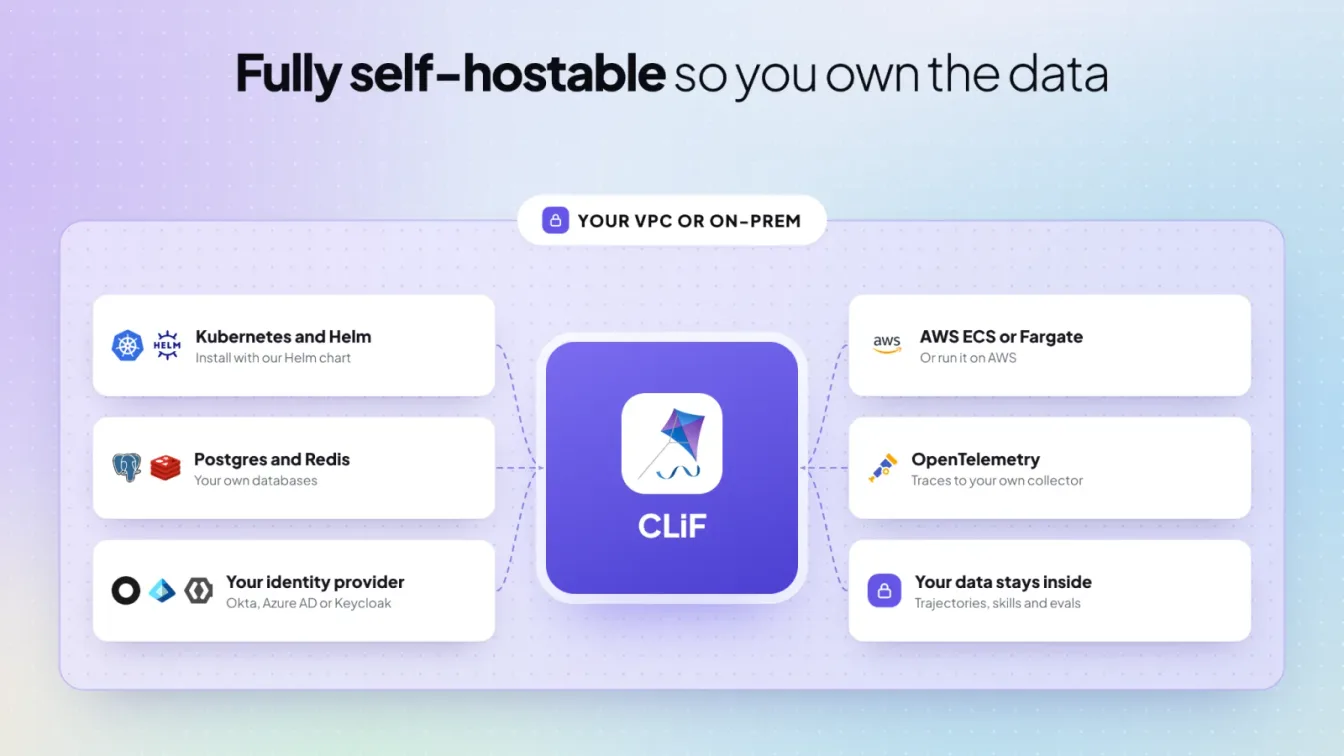
CLiF is fully self-hostable. CopilotKit Intelligence can be self-hosted on a company’s own Kubernetes cluster with a Helm chart, or on AWS ECS and Fargate, with the team’s own Postgres, Redis, and identity provider, such as Okta, Azure AD, or Keycloak.
Trajectories, skills, and everything learned from them stay inside the company’s VPC or on-premises environment, so user activity and agent traces never have to leave its network. Traces can also flow into an existing OpenTelemetry collector. CopilotKit Intelligence also runs on a managed cloud for teams that want the fastest setup.
Key Takeaways
- CopilotKit has released CLiF, a platform for continual learning from full-stack trajectories, now in early access as part of CopilotKit Intelligence.
- How users already do the work is the signal agents are missing. Full-stack trajectories capture it alongside the agent trace, on one timeline over AG-UI.
- CLiF turns those trajectories into four outputs: production-based evals, fine-tuning datasets for smaller open models, skills for agents or MCP servers, and raw trajectories for export, all compatible with existing eval and observability stacks.
- A human reviews every skill, and each one traces back to its source sessions. Published skills reach the agent without a redeploy and can ship with an MCP server for external agents like Claude.
- It targets the core pains of running agents at scale: passing evals, context bloat, cost, fragmented stacks, and oversight of what each agent has learned.
- CLiF works with any agent framework and any model through AG-UI, and it is fully self-hostable.
Teams can learn more, book a demo, or request early access on the CLiF page.
References
- CLiF product page
- Introducing CLiF: The Continual Learning Platform for AI Agents from Full-Stack Trajectories (CopilotKit blog)
- What Is Agent Learning? (CopilotKit)
- CLiF launch video
- CopilotKit Intelligence
- Automatic Learning docs
- Skill delivery docs
Thanks to the Copilotkit team for the thought leadership / resources for this article. This article is sponsored by Copilokit.
The post CopilotKit Releases CLiF: A Continual Learning Platform That Turns Agent Traces and User Actions into Skills, Evals, and Fine-Tuning Data appeared first on MarkTechPost.