← Technology, Science & Infrastructure
▣ Distilled locally
ESP-FLUTTER Is a Robotic Butterfly That Actually Flies
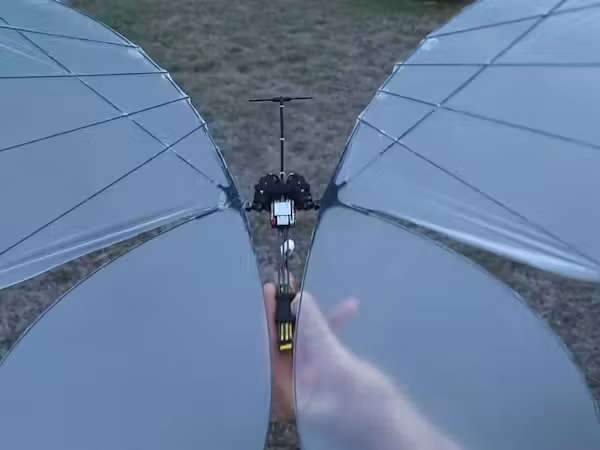
Butterflies are some of nature's most graceful fliers, which makes recreating their delicate movements with a robot very difficult. Most flying robots rely on spinning propellers to generate lift, which is relatively straightforward compared to flapping a pair of wings. That didn't stop maker Max Imagination from developing ESP-FLUTTER, a remote-controlled robotic butterfly that can take to the skies under its own power. It even has illuminated wings to light up the sky during nighttime flights. ESP-FLUTTER is an ornithopter, meaning that it generates lift and thrust by flapping its wings rather than spinning propellers. But unlike many ornithopters that use a single motor and a mechanical linkage to drive both wings, this design uses two independent servos. That gives the butterfly more control over its movements while still keeping the mechanical system reasonably simple. The project is built around a Seeed Studio XIAO ESP32C3 development board, which handles the servo control signals, wireless communications, battery monitoring, and LED lighting. Users can control the butterfly through a smartphone by connecting to its onboard Wi-Fi network and opening a browser-based interface. Alternatively, an optional ExpressLRS receiver allows it to be flown using a conventional RC transmitter. The web interface also provides access to a number of flight settings. Users can adjust the flapping frequency, steering response, servo positions, and wing motion profiles. A sine wave produces smoother, more natural-looking movements, while a triangle wave can generate greater lift. Max Imagination found that a flapping frequency of around 4 Hz works well at full throttle. As you might expect, getting a robotic butterfly airborne takes more than just some well-designed software. Weight is a major concern, so the entire aircraft was kept to just 70 grams. Its frame is 3D-printed from PETG, with flexible TPU guards protecting the servos during crashes. Carbon fiber rods provide the structural support needed to keep the wings lightweight without sacrificing too much rigidity. The wing surfaces are made from thin plastic produce bags stretched over carbon fiber frames and secured with flexible adhesive. It's an inexpensive solution that also helps minimize weight. For those who prefer something a little more conventional, lightweight kite fabric is another option. Power comes from a custom two-cell LiPo battery pack, and a pair of high-speed coreless digital servos provides the muscle needed to flap the wings. Unfortunately, ordinary hobby servos aren't fast or powerful enough for the job. If you're going to make a robotic butterfly, you've got to do it right, so Max Imagination added 50 tiny surface-mount LEDs around the wings. They're connected using extremely thin enameled copper wire, adding only about a gram to each wing. The effect they produce in the dark is well worth that extra weight. Two versions of ESP-FLUTTER are available: a modular design that uses readily accessible components and a more compact version built around a custom four-layer PCB. Both share the same basic operating principles, giving builders a choice between easier assembly and a more integrated design. One of the most interesting aspects of this project is that it doesn't rely on exotic materials or expensive components. With a handful of electronics, some 3D-printed parts, and wings made from discarded plastic bags, Max Imagination has created a flying machine that looks more like something you'd find in a garden than at an RC airfield. ESP-FLUTTER is a robotic butterfly (📷: Max Imagination) A XIAO ESP32C3 is at the core of the hardware (📷: Max Imagination) A web app handles configuration and control (📷: Max Imagination) LEDs light up the night (📷: Max Imagination)
↑ Back to top
Originally published by Hackster News ↗
· rebuilt here from its own full-text RSS feed · all rights
remain with the publisher, please read and support them there.