Caltech Postdoc Awarded L'Oréal USA For Women in Science Grant
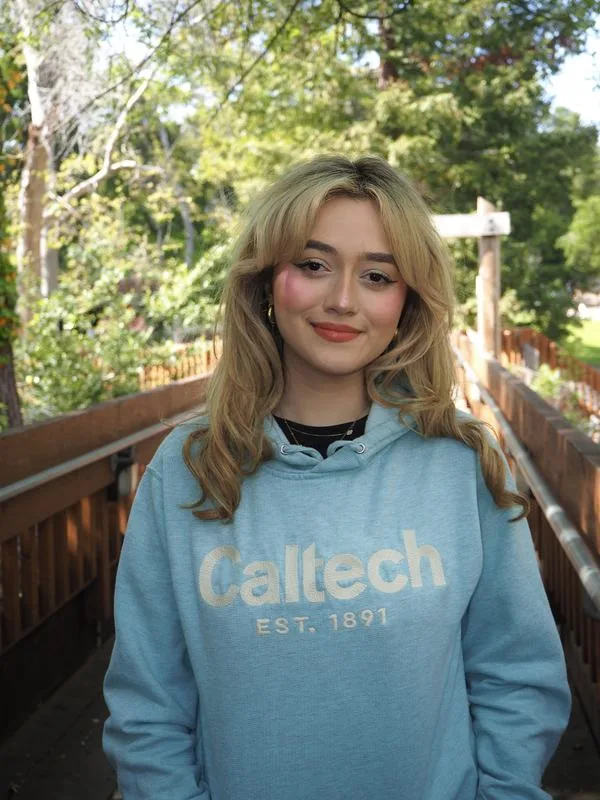
Clarissa Do Ó is among a select group of five postdoctoral scientists to win this year's L'Oréal USA For Women in Science grants for "contributions in Science, Technology, Engineering and Math (STEM) fields and commitment to serving as role models for younger generations," according to the organization's news release.
The grants, which are part of the global L'Oréal-UNESCO For Women in Science International program, aim to "create community and connection for women postdoctoral researchers as they pursue ambitious research projects and attain leadership positions in their fields."
Do Ó says that her ambition can be summed up by one of humanity's most fundamental questions: Are we alone?
"Is there life out there? As far as we know, the only life that exists is here on an Earth-like planet around a Sun-like star," she says. "My main goal would be to find these distant planets that support life by directly imaging them. Getting to see the science and technology being developed toward this goal within my lifetime—and finally seeing a picture of another Earth somewhere else—that's my dream."
Do Ó, who is originally from Brazil, develops telescope technologies that block out the light of stars, making it possible to catch the feeble light of orbiting worlds. These devices, called coronagraphs, sit inside telescopes and act like masks to physically block out a star's light, somewhat like putting your hand up to block the Sun on a hot day. Previously, coronagraph instruments on ground- and space-based telescopes have succeeded in blocking starlight to capture pictures of planets. However, doing so for a twin of Earth is an exceedingly challenging task that may take years to accomplish.
"The goal is to image the reflected light of an Earth twin—that's light that originated from its star and bounced off it in the same way that light from our Sun reflects off the Moon," Do Ó says.
"Direct imaging would enable measurements of atmospheric composition and potential biosignatures, placing Earth in a broader cosmic context. But an Earth twin is approximately 10 billion times fainter than its host star, so we have to suppress the star's light by a factor of 10 billion. This is a formidable optical challenge, but we are already working on this by laying the technical foundations."
Do Ó has been busy studying and testing a type of instrument called a vortex coronagraph, which shifts the phase of starlight in a spiral pattern, allowing that light to be blocked while preserving the light from nearby planets.
The instrument only cancels light that comes straight into the telescope, so if the telescope is pointed directly at a star, the starlight will be removed, leaving the dim light of a nearby orbiting planet.
By refining and improving this technology in labs at Caltech, Do Ó and her team are paving the way toward an advanced coronagraph capable of directly imaging planets like Earth. The exploratory research is part of a NASA mission concept called the Habitable Worlds Observatory.
Do Ó plans to use the L'Oréal grant money to help with another passion: inspiring young women to go into science. She is looking into hosting a workshop for young women, which would include panels on practical advice for getting into graduate school, alternative careers in science, and more. She also hopes to invite some of her science idols, such as Nobel Laureate Andrea Ghez (PhD '92) of UCLA and Caltech's Katie Bouman, professor of computing and mathematical sciences, electrical engineering and astronomy; Rosenberg Scholar; and Heritage Medical Research Institute Investigator, to share their wisdom with the attendees.
Do Ó says her drive to help aspiring women scientists came after she began sharing her own science journey on her Instagram and TikTok platforms, where she has amassed hundreds of thousands of followers. Sharing her day-to-day activities, along with her love of pink and other "girlie" things, she says, is her way of showing women that they can look like anyone.
"I get messages every day from young women telling me that I inspired them to go into science," she says. "One follower just wrote to say she's now getting her PhD at Oxford University. I cry almost every day reading these messages. Even if I'm never a famous scientist, being able to inspire these women is enough."