← Technology, Science & Infrastructure
▣ Distilled locally
Sending Wireless Data With Almost No Power
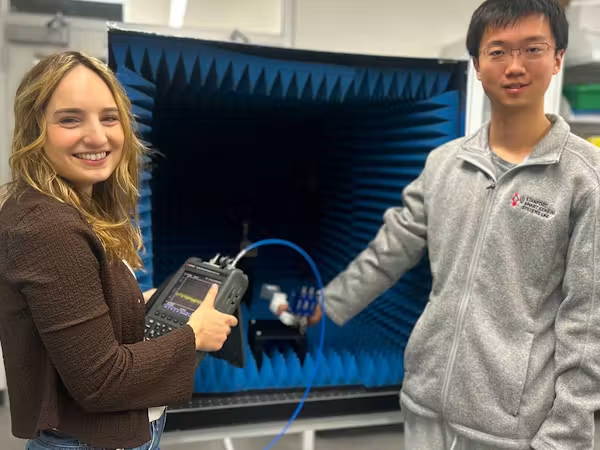
Wireless communication systems typically work by generating radio signals that carry information between devices. Whether it's a smartphone connecting to a cellular network or a sensor transmitting measurements via Wi-Fi, producing those signals requires energy. That can be a problem for battery-powered devices that need to operate for extended periods without maintenance. Researchers at Stanford University have now demonstrated an alternative approach that uses thermal noise to transmit data without generating an active radio signal. Thermal noise is the background electrical static produced by the random motion of electrons in conductive materials. It's normally something that engineers try to eliminate because it interferes with communication signals. But a team led by assistant professor Zerina Kapetanovic has developed a way to use that same noise to transmit information. The technology, called thermal noise communication, isn't entirely new. Kapetanovic previously demonstrated that information could be transmitted by manipulating thermal noise, but there was an important question about how the system worked. Different temperatures produce different amounts of thermal noise, yet her experiments were successful even when the transmitter, receiver, and surrounding environment were all at room temperature. To investigate, the researchers constructed an experimental system inside an insulated chamber that prevented external signals from interfering with their measurements. The setup consisted of a transmitter equipped with an antenna and a receiver that could detect extremely small variations in thermal noise. Rather than generating a conventional radio signal, the transmitter switches between two electrical configurations: an open circuit and a short circuit. These configurations change how the antenna absorbs and reflects thermal noise, with each state representing either a binary zero or one. The receiver uses an amplifier that effectively acts as an electron refrigerator, making the noise it measures appear colder. Depending on the transmitter's electrical configuration, the reflected noise appears either hotter or colder to the receiver, even though neither device actually changes temperature. By detecting these differences, the receiver can distinguish between binary states and reconstruct the transmitted information. Understanding this mechanism allowed the researchers to develop a mathematical model describing how information travels through the system. They then used that model to optimize their experimental hardware and communication scheme, increasing the data transmission rate by approximately 100 times. The resulting system achieved data rates in the kilobits-per-second range. The researchers also demonstrated that polar error-correcting codes could achieve the theoretical channel capacity predicted by their model. Although those speeds are nowhere near what conventional wireless technologies can achieve, thermal noise communication offers a potentially significant advantage in power consumption. According to the researchers, conventional radio frequency transmitters can consume up to 1,000 times more energy to send information. That makes the technology particularly interesting for applications such as environmental monitoring, low-power sensor networks, and RFID systems. It could also prove useful around sensitive medical equipment or radio astronomy instruments, where actively generated radio signals may cause interference. For now, the researchers are investigating how multiple transmitters could communicate over a shared network and whether the system can operate reliably outside the controlled environment of their insulated chamber. If those challenges can be overcome, thermal noise communication could provide a new way for devices to exchange small amounts of information while consuming very little power.Members of the team testing their communication system (📷: Zerina Kapetanovic) Thermal noise communication hardware (📷: Jida Zhang) Experiments were conducted inside an insulated chamber (📷: Jida Zhang)
↑ Back to top
Originally published by Hackster News ↗
· rebuilt here from its own full-text RSS feed · all rights
remain with the publisher, please read and support them there.